
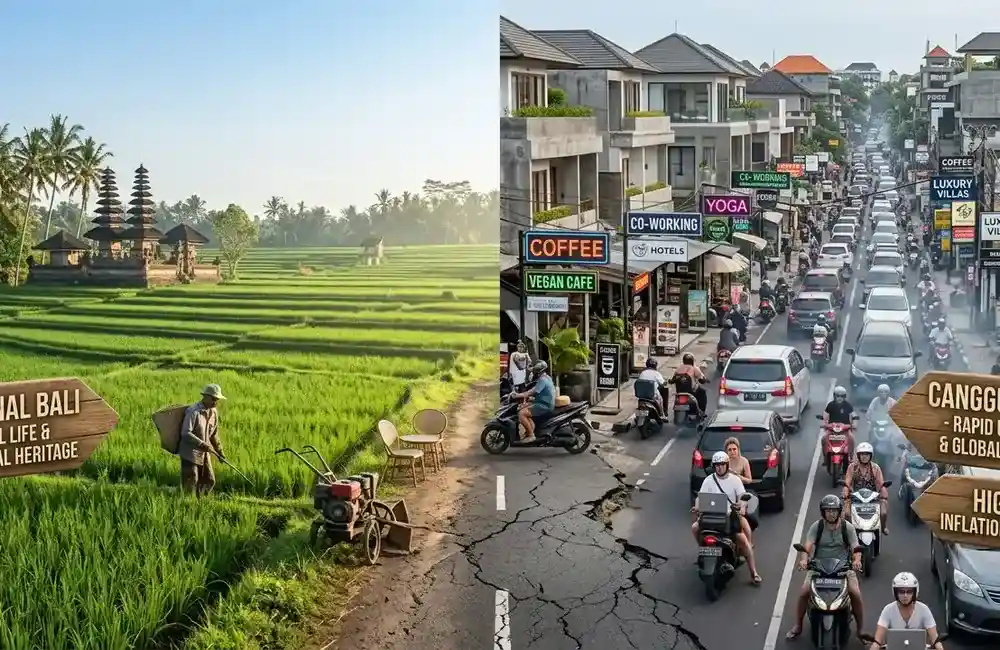
The meteoric rise of Canggu from a sleepy, surf-centric village into a bustling global tourism powerhouse has birthed a prominent real estate phenomenon known as “Canggu-fication.” This term describes the rapid, intense commercialization and urban sprawl that completely transforms rural landscapes into high-density lifestyle hubs. Driven by a massive influx of digital nomads, lifestyle tourists, and foreign capital, this trend has fundamentally rewritten the rules of property investment across the island. While it has brought immense wealth and development to certain sectors, Canggu-fication serves as both a blueprint for commercial success and a cautionary tale regarding market saturation and runaway land inflation.
The Spillover Effect into Neighboring Communities
As central Canggu reaches its geographical and infrastructural breaking point, the forces of Canggu-fication are rapidly bleeding outward into adjacent coastal villages. Areas that were considered remote agricultural zones just a few years ago—such as Pererenan, Seseh, Cemagi, and even the fringes of Kedungu in Tabanan—are now facing the exact same aggressive development patterns. Investors who are priced out of Canggu’s hyper-inflated market are rushing to these neighboring districts to snap up remaining rice fields for boutique villa complexes. This spillover effect creates a fast-moving wave of land transformation, driving up property values exponentially on the outer edges of the south and continuously pushing the boundaries of Bali’s primary real estate hot zones.
Socio-Economic Crises for Local Residents and Infrastructure
The most critical consequence of widespread Canggu-fication is the severe socio-economic displacement of local Balinese communities who can no longer afford to live in their ancestral neighborhoods. Landlords and sellers frequently price their land parcels to match the immense purchasing power of international currency, creating an unbridgeable gap for anyone earning local wages. Beyond the financial strain, the physical infrastructure of these transforming villages is often heavily overwhelmed. Narrow rural roads designed for light village traffic are now plagued by severe gridlocks, while unregulated construction places an unsustainable burden on local waste management systems, water tables, and electricity grids, threatening the very tropical charm that attracted investors in the first place.
The Long-Term Outlook and Investment Sustainability
Ultimately, the phenomenon of Canggu-fication forces both developers and buyers to confront the long-term sustainability of their real estate investments. While building high-density villas in newly trending areas offers highly lucrative short-term rental yields, ignoring the surrounding lifestyle infrastructure introduces immense risks of rapid market depreciation. As traffic congestion peaks and pristine natural views are replaced by continuous concrete blocks, high-paying tourists and expatriates will inevitably seek out the next untouched paradise. To safeguard future investments, the Bali property market must shift its focus away from chaotic over-development and heavily prioritize sustainable zoning laws, community integration, and robust infrastructure development.