
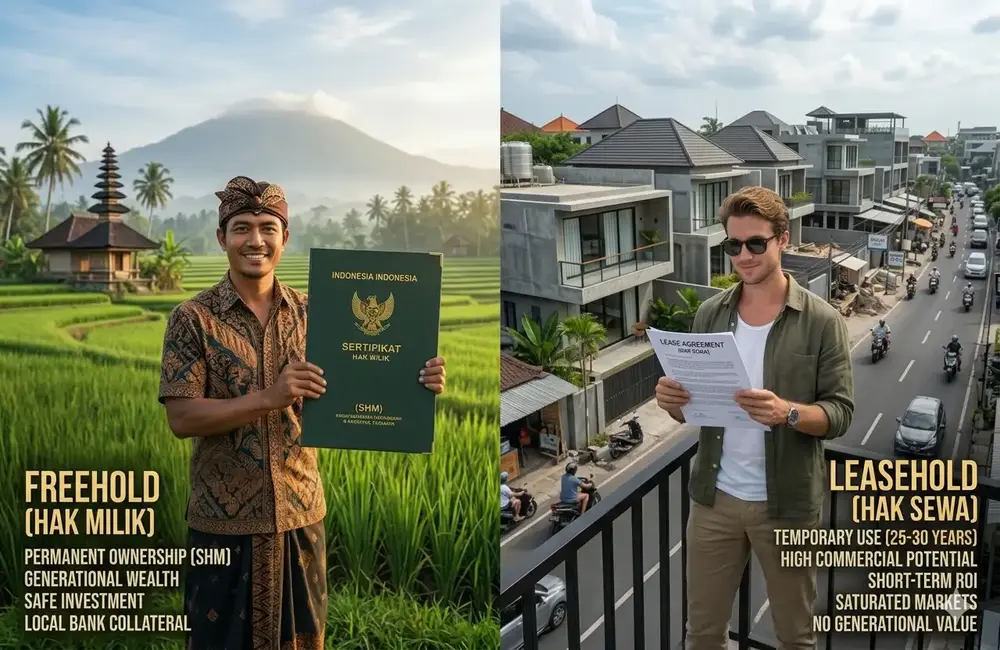
The unprecedented real estate boom in Bali has created a highly competitive and complex market environment for local investors. As foreign buyers flock to the island, they bring immense purchasing power that distorts traditional property values. To navigate this landscape successfully, local investors must thoroughly understand the structural differences between Sertifikat Hak Milik (Freehold/SHM) and Hak Sewa (Leasehold) structures. While foreign buyers are legally restricted to leasing land, their aggressive financial activity directly impacts the availability and cost of permanent land ownership. Mastering these property dynamics is the most effective way for local buyers to safeguard their wealth and make informed, long-term real estate decisions.
How Foreign Leaseholds Drive Up Freehold Prices
Under Indonesian law, foreign nationals are prohibited from directly owning Freehold (Hak Milik) land, steering them instead toward long-term Leaseholds (Hak Sewa). Because international investors wield strong global currencies, they are often willing to pay premium prices to lease a plot of land for 25 to 30 years. Local landowners quickly realized they could earn massive upfront cash injections by leasing their land to foreigners rather than selling it permanently. This trend has created an artificial scarcity of Freehold land on the market. Consequently, when a Freehold plot does become available, its asking price is heavily inflated to compete with the lucrative returns generated by the foreign leasehold market.
The Strategic Advantage of Securing Freehold (SHM) Property
For local Indonesian investors, prioritizing Sertifikat Hak Milik (SHM) remains the ultimate golden strategy despite the challenging price barriers. Unlike a Leasehold, which depreciates in value as the lease expiration date approaches, a Freehold asset offers permanent ownership and perpetual capital appreciation. Holding an SHM provides total legal security, absolute control over property modifications, and the valuable right to pass the asset down through generations. Furthermore, Freehold properties serve as excellent financial leverage, as local banks readily accept SHM certificates as high-value collateral for housing loans (KPR) or business expansion capital—a benefit that temporary leaseholds simply cannot match.
Finding the Right Balance in a Competitive Market
Ultimately, choosing between Freehold and Leasehold depends on your immediate investment goals and financial liquidity. If your primary objective is to build a fast commercial business, such as a trendy cafe or a short-term rental villa, entering a mid-term Leasehold can lower your initial capital requirements and maximize immediate cash flow. However, if your long-term goal is stability, generational wealth creation, or securing a permanent residential home, saving for a Freehold property is undeniably the safer and more profitable path. By expanding your search to emerging growth corridors outside hyper-inflated tourism zones, you can still find genuinely priced Freehold land that will steadily appreciate securely over time.