
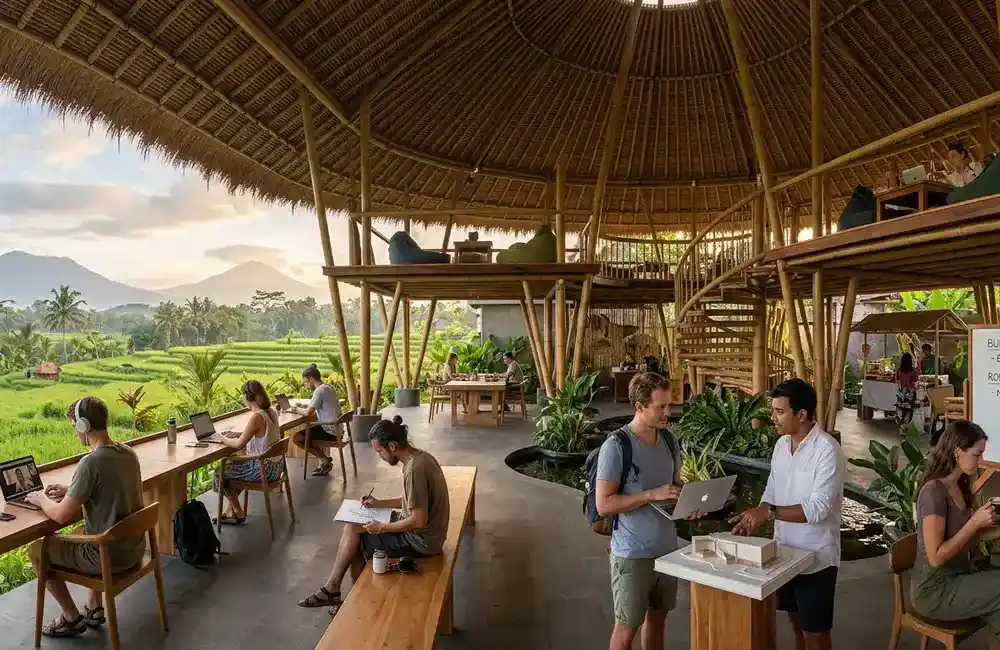
The unprecedented influx of digital nomads, remote entrepreneurs, and creative professionals over the past few years has fundamentally altered the socio-economic fabric of Bali. This shift has triggered a massive evolutionary wave across the island’s real estate sector, moving property demands away from traditional holiday villas or standard long-term residential rentals toward highly flexible, functional, and shared environments. As thousands of international workers establish Bali as their semi-permanent base, a new digital nomad economy has emerged, rewriting the rules of local real estate development. The structural consequence of this phenomenon is the rapid rise of innovative co-living spaces—a distinct architectural movement that seamlessly blends professional functionality with community-driven residential living to accommodate a transient yet highly demanding global workforce.
From Traditional Villas to Community-Centric Micro-Units
The physical design of Bali’s new residential developments is undergoing a radical spatial reconfiguration to optimize utility and foster human connection. Historically, high-end real estate in Bali focused heavily on expansive, isolated luxury villas that featured sprawling open-plan layouts, large private swimming pools, and enclosed perimeters designed for absolute privacy and short-term relaxation. Today’s co-living developments completely reject this individualistic layout, choosing instead to prioritize highly optimized micro-apartments or compact private suites wrapped around massive, interconnected communal areas. Modern architects are intentionally designing properties where private living quarters are minimalistic and compact, focusing square footage instead on shared infrastructure like sprawling open-air kitchens, multi-tiered lounge decks, and community garden spaces. This architectural strategy drastically lowers the initial capital and rental barriers for individual occupants while naturally constructing an organic networking ecosystem where residents can interact, collaborate, and build relationships daily.
Incorporating High-Performance Workspaces into Residential Layouts
A defining architectural hallmark of modern Bali co-living developments is the absolute necessity of integrating high-performance, professional-grade workspace infrastructure directly into the residential zoning plan. It is no longer sufficient for a property developer to merely place a basic desk and a chair in the corner of a bedroom; modern remote workers require a sophisticated environment that mirrors the utility of a cutting-edge corporate office. Consequently, contemporary co-living blueprints feature dedicated architectural zones equipped with soundproof Skype and Zoom booths, climate-controlled hot-desking rooms, and formal presentation spaces outfitted with advanced multimedia technology. Integrating these high-utility workspaces requires a deeply meticulous architectural approach to spatial acoustics, structural insulation, and robust power grid stability to support uninterrupted high-speed fiber-optic backbones. Architects must masterfully balance natural ambient lighting to prevent screen glare while configuring physical pathways so that residents can transition effortlessly from a relaxed morning swim to an intensive international executive meeting without ever leaving the physical premises.
Sustainable Practices and Adaptive Reuse in Co-Living Design
As the demand for co-living spaces escalates, the architectural methods used to construct them are shifting heavily toward environmental sustainability and adaptive reuse. Because a vast majority of digital nomads and remote workers express a deep personal alignment with eco-conscious living, modern developers in progressive hubs like Ubud, Pererenan, and Seseh are pushing the boundaries of green architecture. Instead of relying solely on traditional, high-emission concrete structures that trap tropical heat, architects are actively blending sustainable, locally sourced materials such as treated structural bamboo, rammed earth, and recycled ironwood with sleek, industrial design elements. Furthermore, the physical layout of these modern co-living compounds is strategically engineered to harness natural cross-ventilation and maximize natural daylight, drastically mitigating the massive energy consumption typically associated with continuous air conditioning. By introducing advanced rainwater harvesting systems, blackwater recycling setups, and solar panel arrays into the structural design, developers are proving that high-density communal living can actively protect Bali’s delicate and overextended natural ecosystem.
Balancing Modern Technical Utility with Balinese Spatial Philosophy
True architectural sustainability in Bali’s highly competitive co-living market extends far beyond eco-friendly building materials to encompass a profound sense of cultural and social integration within the local neighborhood. Forward-thinking architects and developers are consciously structuring co-living facilities to respect and reflect traditional Balinese spatial philosophies, frequently incorporating foundational elements of Tri Hita Karana—the ancestral philosophy emphasizing total harmony between humans, nature, and the spiritual realm. This cultural integration manifest physically through the preservation of existing old-growth trees, the incorporation of traditional central courtyards (natah), and the widespread use of authentic local stone carvings and open-air pavilion designs. By intentionally designing porous physical boundaries and leaving spatial transitions open to the surrounding village landscape, these modern co-living properties successfully avoid becoming isolated, gentrified enclaves. Instead, they foster a deeply respectful, harmonious coexistence where transient international workers can learn from and support the permanent local banjars that form the true heart of Bali.
The Future of Bali Property Investment in the Remote Work Era
Ultimately, the powerful rise of the digital nomad economy has permanently disrupted Bali’s real estate landscape, demonstrating that spatial flexibility and authentic community connection are now just as financially valuable as raw physical square footage. For local landowners, developers, and forward-thinking property investors, pivoting toward co-living architecture represents a highly resilient and future-proof asset class. These community-centric developments are uniquely capable of generating incredibly consistent, year-round rental yields that remain largely insulated from the volatile seasonal fluctuations that typically plague traditional tourism-dependent luxury villas. As long as the island of Bali retains its global reputation as a premier magnetic hub for remote talent, the real estate projects that achieve long-term commercial success will be those that masterfully balance cutting-edge digital utility with sustainable, community-driven spatial designs.